
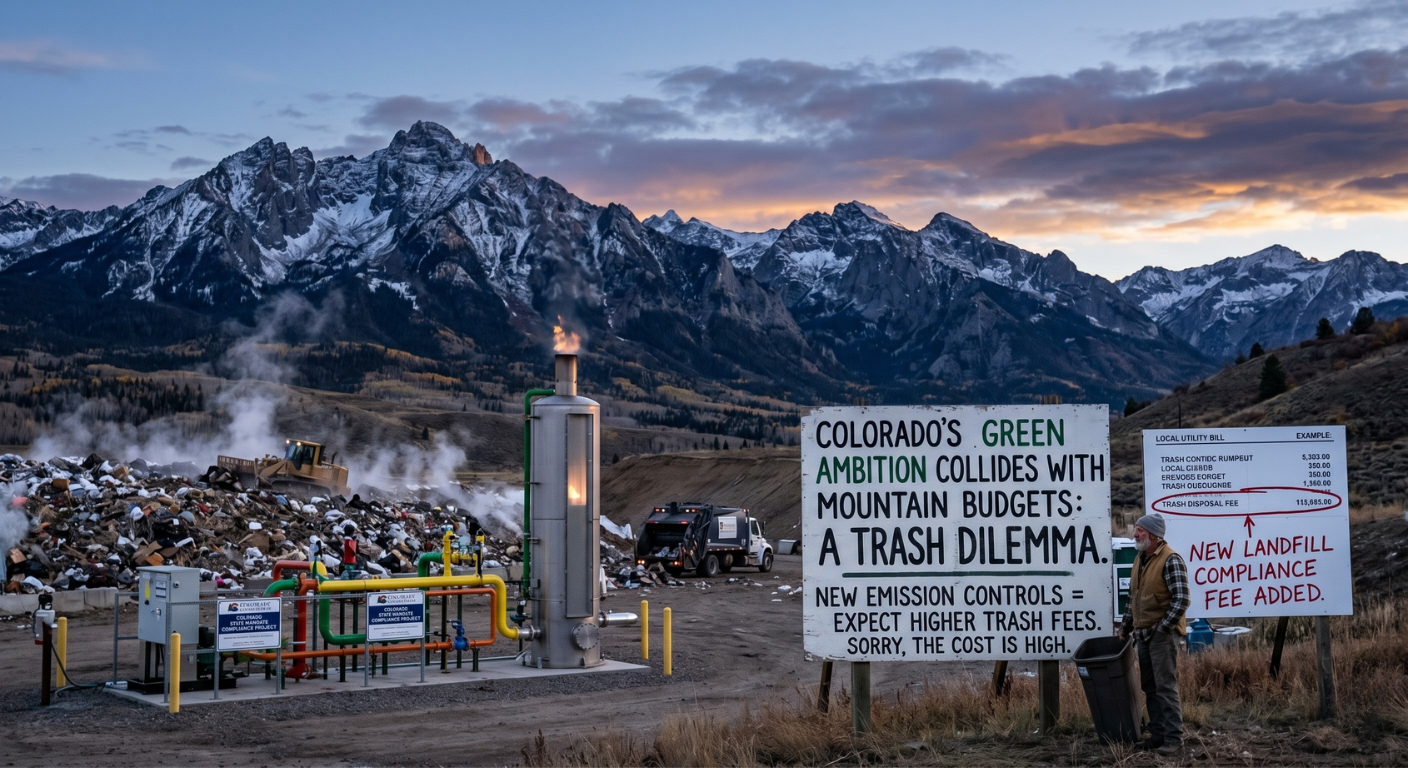
In Colorado’s majestic high country, a complex environmental challenge is brewing, threatening to hit residents where it hurts most: their utility bills. New state-mandated emission controls for landfills, designed to curb potent greenhouse gas releases, are prompting warnings from local officials in mountain counties that a significant increase in trash collection fees for residents may be unavoidable.
The rules, enacted last year by the Colorado Air Quality Control Commission (AQCC), aim to drastically reduce methane emissions from landfills across the state. Methane, a byproduct of decomposing organic waste, is a greenhouse gas far more potent than carbon dioxide in the short term, making its reduction a critical component of Colorado’s ambitious climate goals. While the environmental benefits are clear, the financial implications for smaller, often geographically isolated mountain landfills are proving to be a formidable hurdle.
The core of the challenge lies in the capital investment and ongoing operational costs required to comply with the new mandates. Landfills must now implement more sophisticated gas collection systems, which involve drilling wells into the waste, installing extensive piping networks, and utilizing flares or, ideally, energy recovery systems to capture and neutralize the methane. This infrastructure is costly to install, maintain, and monitor, requiring specialized equipment and skilled personnel.
For large, high-volume landfills serving dense urban populations on the Front Range, these costs, while significant, can be amortized across a vast customer base. However, mountain counties present a starkly different scenario. Their landfills typically serve much smaller populations, meaning a narrower revenue stream to absorb substantial new expenses. The economies of scale simply don’t favor these smaller operations.
Furthermore, the rugged terrain, harsher weather conditions, and relative remoteness of many mountain communities exacerbate the problem. Construction and maintenance of complex gas collection systems in these environments can be more challenging and expensive, requiring specialized transport and potentially longer project timelines. Access to skilled technicians for installation and ongoing monitoring also poses a greater logistical and financial burden compared to more accessible urban areas.
Local government officials, often operating on already tight budgets, are caught between a state environmental imperative and the practical reality of maintaining affordable public services for their constituents. They warn that without significant state assistance or alternative solutions, the only viable path to cover these new costs will be to pass them directly onto residents through higher trash collection and disposal fees. For communities where residents already face a high cost of living, even a modest increase in essential services can have a disproportionate impact, particularly on fixed-income households or those working in the region’s prevalent service industries.
The issue has not gone unnoticed by state lawmakers, who are now actively engaged in seeking legislative solutions. The dilemma underscores a fundamental tension in environmental policy: how to achieve vital climate goals without unduly burdening specific communities, especially those with unique economic and geographic constraints. Discussions are reportedly underway regarding potential state grants, low-interest loans, or other forms of financial aid to help mountain counties upgrade their landfill infrastructure. Another avenue being explored includes potential exemptions or phased implementation plans for the smallest facilities, although this would need to be carefully balanced against the overarching environmental objectives.
Beyond direct financial aid, the conversation is also sparking broader discussions about regional collaboration and long-term waste management strategies in Colorado. Could smaller mountain counties pool resources to create regional waste management authorities, potentially consolidating services or investing in shared facilities like composting operations or waste-to-energy plants that reduce landfill dependence altogether? While such initiatives represent significant upfront investments and require complex inter-county agreements, they could offer more sustainable and economically viable solutions in the long run.
Environmental advocates, while acknowledging the financial challenges, emphasize the critical importance of reducing methane emissions. They point to the measurable impact these gases have on atmospheric warming and air quality. They argue that innovative solutions are needed to support communities in adopting cleaner practices, rather than diluting the environmental standards themselves. The dialogue often circles back to the principle that while local communities bear the brunt of compliance, the benefits of mitigating climate change are statewide and global.
As Colorado continues its pursuit of a greener future, the predicament faced by its mountain counties highlights the intricate balance between ambitious environmental mandates and the practical economic realities on the ground. The current legislative efforts aim to forge a path forward that protects Colorado’s pristine environment without placing an unbearable financial strain on its high-country residents. The outcome of these discussions will not only determine the future of trash bills in the mountains but also set a precedent for how the state navigates similar environmental challenges in the years to come, ensuring that all communities can contribute to and benefit from a more sustainable Colorado.
Source: Summit Daily

0 Comments